The Four Rules of Fabric Selection
Fabric for woven wraps, slings, and structured carriers should follow these four rules.| 1) Fiber Content | Natural fibers like cotton or linen. | Exception: Water Carriers |
| 2) Weave | Thick visible threads, no stretch, tight weave | Exception: Stretchy wraps |
| 3) Weight | Sturdy like denim trousers or a strong tote bag. | Exception: None |
| 4) Care Instructions | Machine Washable | Exception: Wool |
Fiber Content
The "fiber content" is displayed on the tag or bolt and tells you what the threads of the fabric were made out of. If your fabric is unlabeled, you can do a burn test to help determine approximately what the fabric might be made of. Burn test info link is below the fiber content table.| Fiber Type | Recommended? | Details | Exceptions |
|---|---|---|---|
| Cotton | Yes | Easy to find and typically inexpensive. Usually breathable and easy to care for. Shrinks up to 20% after the first wash/dry | no exceptions |
| Linen, Flax | Yes | Very strong & breathable in the heat. Shrinks up to 10% after the first wash/dry. | Always check the tag for fiber content, as many "linen" fabrics are actually "linen-like polyester blend" fabrics. |
| Hemp | Yes | Incredibly strong. Can be difficult to "break in" or soften. | no exceptions |
| Wool | Yes | Softness and breathability depends heavily on weave. Known for excellent temperature regulation in both heat and cold. MUST be gently hand washed and laid flat to dry. | no exceptions |
| Silk | Yes | Very strong despite being very thin in hand. Raw silk is nubby and matte in appearance. Dupioni or shantung are much shinier. | Avoid tissue-thin silk like charmeuse. Double check fiber content to avoid "silk-like" polyester and rayon imitations. |
| Rayon, Bamboo, Viscose | Yes, if under 50% | Semi-synthetic fibers made from a variety of plants. Typically very breathable, but thinner and a bit slippery. Best if blended with cotton or linen. | No exceptions |
| Spandex, Lycra | No | Avoid for use in all carriers except stretchy wraps and dual pouch carriers. | Under 5% is okay for use in a stretchy wrap. 100% lycra is fine for a water-use stretchy wrap |
| Polyester, Nylon, Acrylic | No | Despite being strong, these synthetic fibers are slippery, don't hold knots well, and don't typically breath well, which can cause baby to overheat. A blend of less than 25% polyester is fine. | Water carriers should be made from 100% synthetic fibers which won't absorb water or be broken down by chlorine. |
| "Other/Mixed Fibers" | No | No mysteries allowed! | no exceptions |
| Metallic threads | No | Generally avoid altogether, but if the percentage is under 5%, judge by feel. Metallic threads can be extremely scratchy against baby's skin and break down and flake when washed. | no exceptions |
If your fabric is unlabeled, you can do a burn test to help determine approximately what the fabric might be made of.
Weave
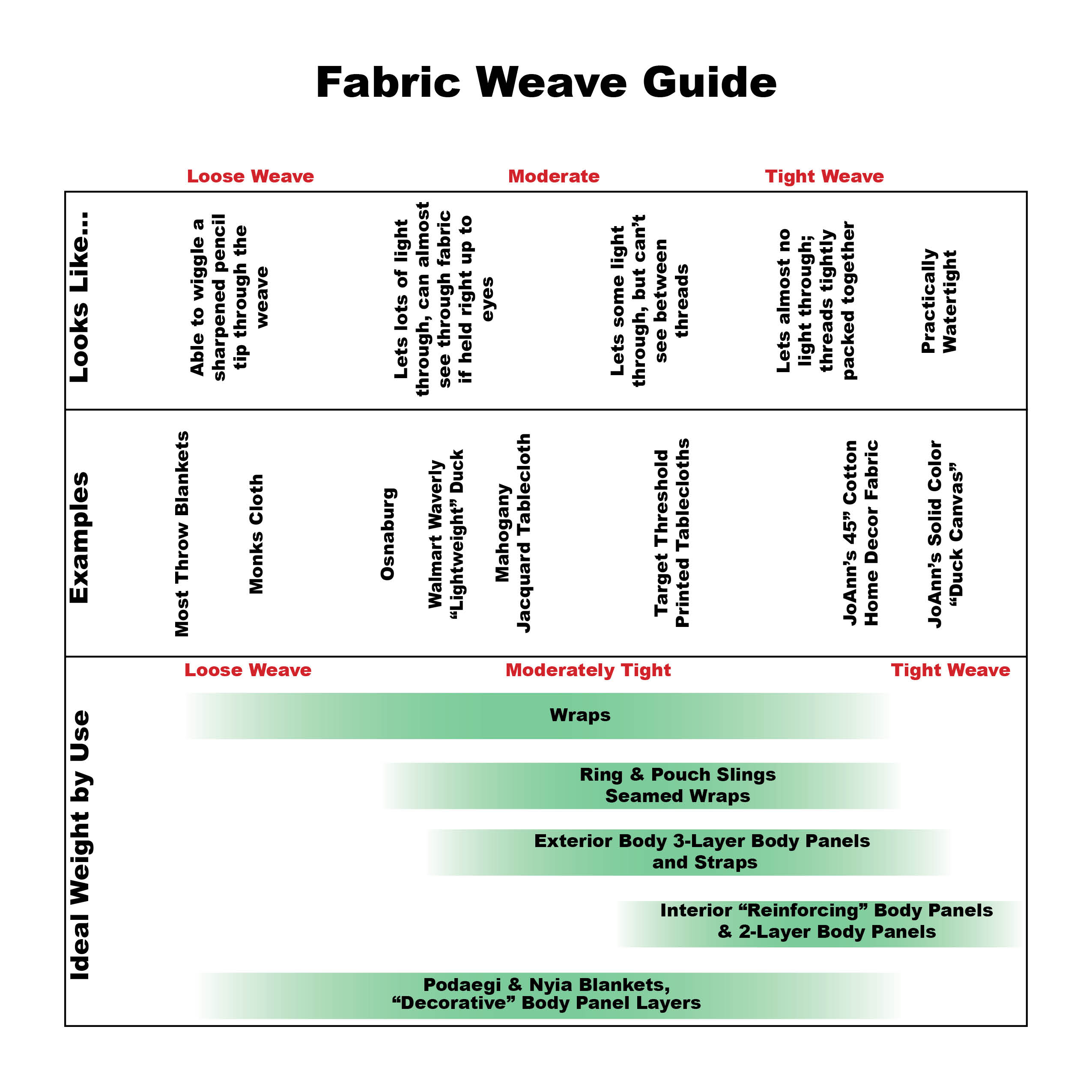 The threads of the fabric should be moderately thick and visible, tightly woven together, and should have no lengthwise or widthwise stretch.
Unlike bedsheets, with babywearing, typically a lower threadcount is more desirable. Which would you trust to tow a car with: a few heavy chains, or a hundred dainty necklaces? The threads should not look “fuzzy” like flannel, fleece, or brushed twill. Fuzzy threads indicate a pre-distressed fabric that is more
likely to tear. The threads should be close together and should allow minimal light between them. You should not be able to easily see between the threads to the other side of the fabric.
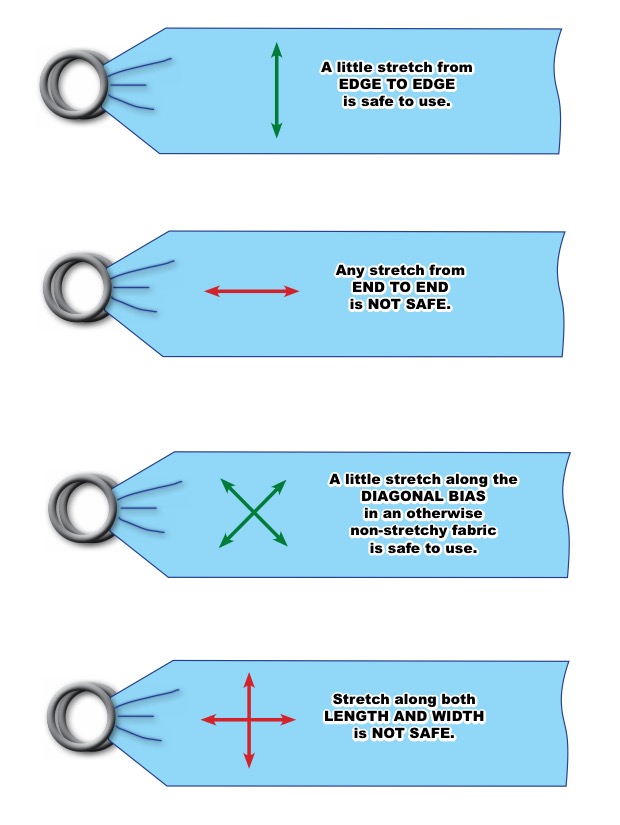
Fabric for structured carriers (with multiple pieces of fabric attached together) should have no stretch at all, except perhaps a small amount of diagonal give. Fabric for wraps and slings may have a small amount of stretch along the width (selvedge to selvedge) but should have no stretch along its length. Fabric for stretchy wraps can stretch in all directions, although it should eagerly “bounce” back to its original shape.
Weight
As a general rule, fabric for babywearing should be “bottom weight” – that is, sturdy enough that it could be used to make a pair of trousers out of. Try to imagine whether the fabric would make a good tote bag for carrying lots of books. Avoid fabrics that feel thin, like a dress shirt, handkerchief, or bedsheets.
Fabric “weight” is measured in it’s weight divided by it’s area. In Imperial, this is measured in ounces per square yard (oz/sq yd) and in Metric, in
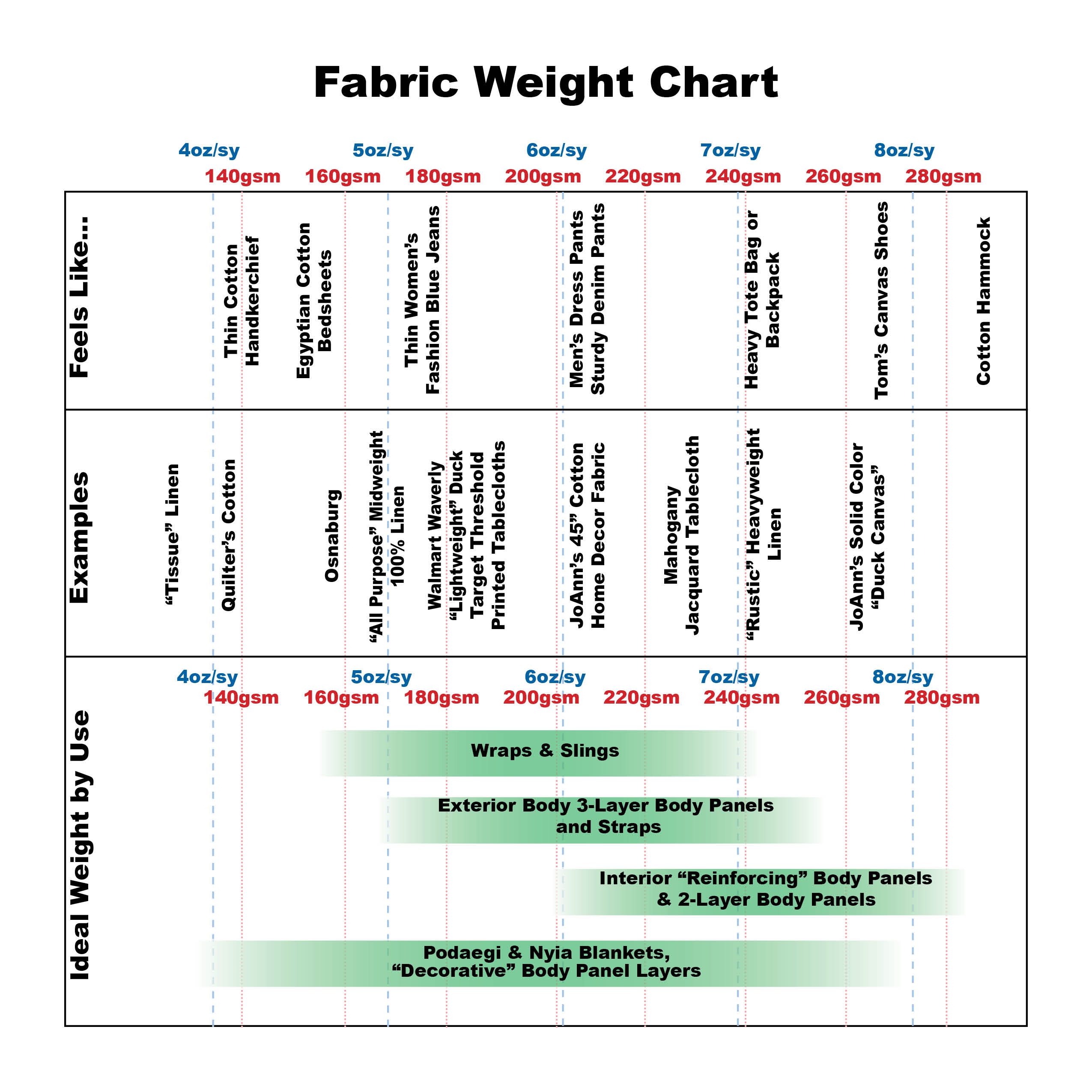
grams per square meter (gsm.)
Fabric weight can vary based on what you are making. For a wrap or sling, osnaburg is considered the absolute minimum in weight, coming inaround 160gsm or 4.8 oz/sq yd. Osnaburg makes up for it’s light weight by having thicker threads, which makes it stronger than a similarly-weighted muslin. Osnaburg is, unforunately, too thin to use for body panel pieces in structured carriers. For wraps and slings, the maximum weight depends a lot on the weave of the fabric. Tightly woven duck cloth, for example, is only thin enough to make a nice floppy wrap up to about 200gsm or 6 oz/sq yd, however 240gsm or 7 oz/sq yd linen fabric makes for a great wrap. It is preferable to shop by feel in most cases. Fabric for wraps will feel sturdy in hand (perhaps even a little bit stiff off the bolt) but will still drape nicely.
For structured carriers, the minimum would be more like 180 gsm or about 5.3 oz/sq yd duck cloth or canvas, with something above 200gsm or 6 oz/sq yd being preferred, particularly if being used for an interior “hidden” layer to a body panel to hide the reinforcement stitches.
Machine Washable
This may seem like a minor convenience factor, but it is just as equally safety related as the previous three rules. Fabrics for babywearing should be labeled as machine washable (with the exception of wool, which I will discuss below.) Fabrics that specify “wipe with a damp cloth” or “spot clean only” or “dry clean only” are often either coated or backed with chemicals that you wouldn’t want in a baby’s mouth (and, in case you are wondering, yes, babies put wraps and carriers in their mouths.)
Home decor fabrics that are “dry clean only,” assuming they don’t have any kind of backing on the back side of the fabric, are a bit of a gray area. Especially when combined with the phrase, “fabric may crock,” it typically just means that the dye is not terribly well bonded to the fabric, which means it could rub off (on you, your baby’s skin, or in their mouth.) Some people choose to simply give these fabrics a hot wash and dry to remove any excess dye, while others choose to avoid these fabrics entirely. It is up to you to do your own research and make the right decision for your family.
Regarding wool, while it is a safe fiber type to use, it is prone to felting when exposed to moisture and friction (which is exactly what a washing machine does.) Typically the washing instructions for wool are to put it in a sink or tub full of water with either a little bit of wool wash or even just vinegar, let it soak for 10-15 minutes, rinse it in warm water, and then dry it without any stretching or abuse, by rolling it in a towel neatly, and then laying it flat to dry.